Site Preferences


Follow Us


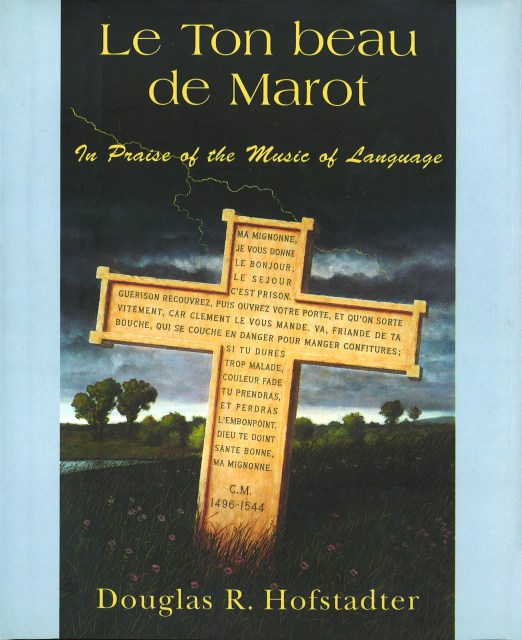
Le Ton beau de Marot
In Praise of the Music of Language

Contributors
Formats and Prices
- On Sale
- May 23, 1998
- Page Count
- 832 pages
- Publisher
- Basic Books
- ISBN-13
- 9780465086450
Price
$49.99Price
$62.99 CADFormat
Format:
Trade Paperback $49.99 $62.99 CADThis item is a preorder. Your payment method will be charged immediately, and the product is expected to ship on or around May 23, 1998. This date is subject to change due to shipping delays beyond our control.
Buy from Other Retailers:
“An exhilarating blend of autobiography, analysis, wordplay, and elegy… a source of myriad delights.” –Washington Post
Lost in an art—the art of translation. Thus, in an elegant anagram (translation = lost in an art), Pulitzer Prize-winning author and pioneering cognitive scientist Douglas Hofstadter hints at what led him to pen a deep personal homage to the witty sixteenth-century French poet Clément Marot.
Not merely a set of translations of one poem, Le Ton beau de Marot is an autobiographical essay, a love letter to the French language, a series of musings on life, loss, and death, a sweet bouquet of stirring poetry—but most of all, it celebrates the limitless creativity fired by a passion for the music of words. Rife with stunning form-content interplay, crammed with creative linguistic experiments yet always crystal-clear, this book is meant not only for lovers of literature, but also for people who wish to be brought into contact with current ideas about how creativity works, and who wish to see how today’s computational models of language and thought stack up next to the human mind.
Le Ton beau de Marot is a sparkling, personal, and poetic exploration aimed at both the literary and the scientific world, and is sure to provoke great excitement and heated controversy among poets and translators, critics and writers, and those involved in the study of creativity and its elusive wellsprings.
Genre:
-
“Douglas Hofstadter has triumphantly returned with a companion volume to his youthful masterwork, an inquiry into the nature of language and translation, an exhilarating blend of autobiography, analysis, wordplay, and elegy… a source of myriad delights.”Washington Post
-
“Not even Hofstadter’s brilliant Gödel, Escher, Bach prepared me for this new book, which takes a spirited lyric by a little-known poet of the Renaissance and uses it as a launching pad for one of the most thought-provoking discussions of literary translation I have read. More than a scholarly study, the text is also an autobiographical work, helping the author do the work of bereavement for his late wife and producing a book that, though written in prose, has poetic qualities. He has demonstrated that deep humanity and the magic of form are wonderfully compatible, by composing a ‘translation’ of his beloved spouse into an enduring verbal icon.”Alfred Corn, poet and essayist
-
“This book does indeed represent ‘the play of the mind’ upon a subject; and its playfulness makes possible a swift keen-minded, engaging treatment of many facets and instances of translation. Le Ton beau de Marot is sprightly and absorbing throughout.”Richard Wilbur, poet and literary translator
-
“This book is worthy of the author of Gödel, Escher, Bach, being just as intelligent and unexpected. The expert on A.I. has contrived to illustrate a huge array of intelligence and translation problems by concentrating his attention on a delicate little trifle of a poem, written 400 years ago by Clément Marot. The result is a book like no other – odd, personal, polyglot, and, above all, accessibly intelligent.”Sir Frank Kermode, author of The Sense of an Ending
-
“What Douglas Hofstadter is, quite simply, is a phenomenologist, a practicing phenomenologist, and he does it better than anyone else. Ever. For years he has been studying the process of his own consciousness, relentlessly, unflinchingly, imaginatively, but undeludedly…; he watches his own mind work the way a stage magician watches another stage magician’s show, not in slack-jawed awe at the magic of it all, but full of intense and informed curiosity about how on earth the effects might be achieved.”Daniel Dennett, author of Darwin’s Dangerous Idea